Berkeley Open Infrastructure for Network Computing
From Wikipedia, the free encyclopedia 
The Berkeley Open Infrastructure for Network Computing (BOINC, pronounced /bɔɪŋk/ –rhymes with "oink") is an open-source middleware system for volunteer computing (a type of distributed computing). Developed originally to support SETI@home, it became the platform for many other applications in areas as diverse as medicine, molecular biology, mathematics, linguistics, climatology, environmental science, and astrophysics, among others. The purpose of BOINC is to enable researchers to utilize processing resources of personal computers and other devices around the world.
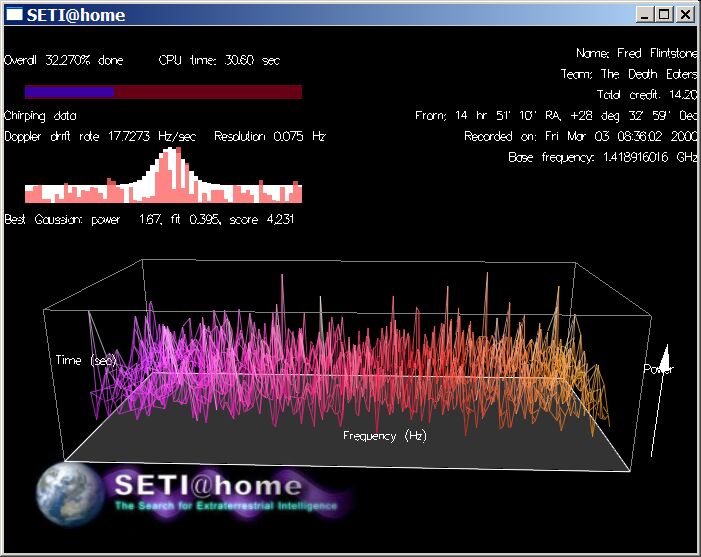
BOINC development began with a group based at the Space Sciences Laboratory (SSL) at the University of California, Berkeley, and led by David P. Anderson, who also led SETI@home. As a high-performance volunteer computing platform, BOINC brings together 34,236 active participants employing 136,341 active computers (hosts) worldwide, processing daily on average 20.164 PetaFLOPS as of 16 November 2021 (it would be the 21st largest processing capability in the world compared with an individual supercomputer). The National Science Foundation (NSF) funds BOINC through awards SCI/0221529, SCI/0438443 and SCI/0721124. Guinness World Records ranks BOINC as the largest computing grid in the world.
BOINC code runs on various operating systems, including Microsoft Windows, macOS, Android, Linux, and FreeBSD. BOINC is free software released under the terms of the GNU Lesser General Public License (LGPL).
Edited by user
8 months ago |
Reason: Not specified